IBM Maximo Real Estate and Facilities · Portfolio transactions
Renew, move, buy or sell? Compare them first
A lease is ending in Charlotte. The company can stay on the current terms, renew, let the lease expire, leave early, sign a new lease elsewhere, buy a building, sell the one it owns, or sublet what it doesn't need. Here is how a portfolio manager puts all of those options side by side in Maximo Real Estate and Facilities (MREF), on one real example, with every number on the screen explained.
- What a transaction plan is, and why it is the record that governs a real estate decision.
- How business needs become measurable CTQ requirements (critical to quality).
- How each option becomes a transaction project, and options are grouped into scenarios.
- How to read NPV, total commitment and the sigma scores that rank the scenarios.
- How the winning deal's financial terms flow into the lease that the lease administrator manages afterwards.
Reading time: about 15 minutes. Companion posts: capital planning, space planning and lease administration.
Before we startPortfolio transactions in two minutes
Every few years each building in a portfolio reaches a decision point: a lease expires, the team grows or shrinks, a building gets too expensive to run. The options are always the same handful: renew, renegotiate, expire and move, terminate early, sign a new lease, buy, sell or sublet. They are big decisions: millions of dollars committed for ten years or more.
Without a tool, each option ends up in its own spreadsheet, with its own assumptions, and nobody can compare them fairly. A transaction plan in MREF holds the requirements, every option, the financial model of each, and a scored comparison, in one record that leadership can sign off.
Our example. GreenPoint Corporation rents the Watson Center in Charlotte, the building from the
lease administration post. Its portfolio manager, Manny Deals (demo login
mdeals), has to decide what to do with it. The demo data dates from 2014 to 2017; the method is the same today.
There is no Maximo equivalent of this module: Maximo manages the assets inside a building, not the decision to keep the building. The closest idea is a business case attached to a capital project, but here the business case is the record, with the options and their financial models inside it.
Chapter 1The transaction plan
Everything starts with one record: the RE Transaction Plan. Its General tab says what the deal is, where, how urgent it is, and who works on it.
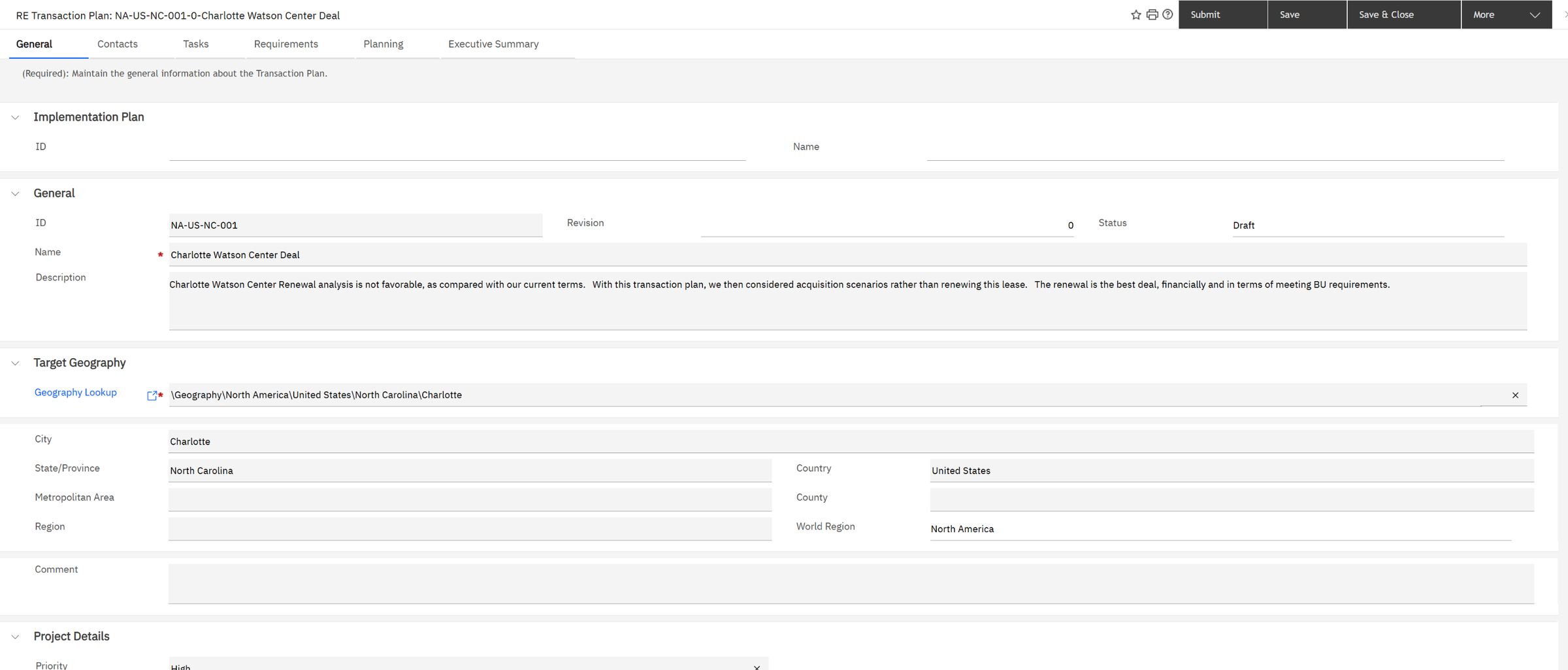
Read the tabs from left to right and you have the whole method: General (what), Contacts (who: brokers, lawyers, the business sponsor), Tasks (the work to do), Requirements (what the business needs), Planning (the options) and Executive Summary (the comparison).
Think of the transaction plan as a parent work order whose children are the options: the plan carries the status, priority and team, and each child option (a transaction project) carries its own costs and dates.
Chapter 2What does the business actually need?
Before looking at any building, the plan records the requirements as measurable targets, called CTQs (critical to quality, a Six Sigma term). Each one is a number or a date that an option either meets or misses.
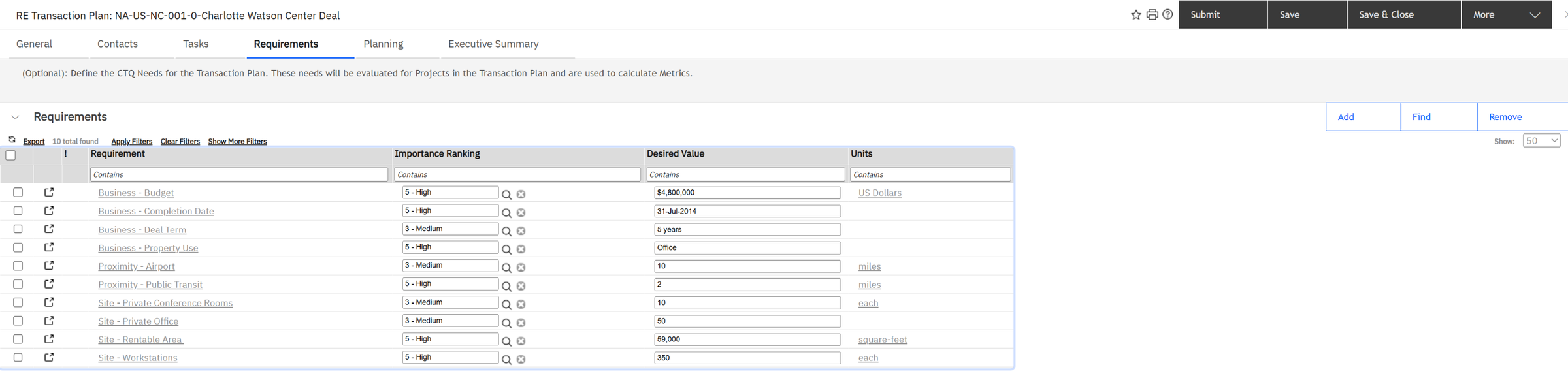
| Requirement | Target | Why it matters |
|---|---|---|
| Budget | $4.8M | The ceiling the business will fund. |
| Completion date | 31 July 2014 | When the team must be in. |
| Lease term | 5 years | How long the business wants to commit. |
| Rentable area | 59,000 sq ft | What will be paid for. |
| Workstations / offices / conference rooms | 350 / 50 / 10 | Headcount the space must hold. |
| Airport / public transit | within 10 mi / 2 mi | Location constraints that rule buildings out. |
| Use | Office | Zoning and building type. |
59,000 sq ft ÷ 350 workstations ≈ 169 sq ft per workstation, rentable. That is within the range of a typical office (roughly 150–250 sq ft per seat, common areas included), so the requirement is consistent. If it came out at 100, the brief would be asking for too many people in too little space, and you would catch it here, before any deal.
Writing the targets down before the options keeps the comparison honest: each option is scored against the same CTQs, not against whatever its sponsor chose to highlight.
Chapter 3Every option as a transaction project
The Planning tab holds the options. Each one is a transaction project with its own type, and each type has its own financial model: a renewal has new rent, a purchase has a price and running costs, a sale has proceeds.
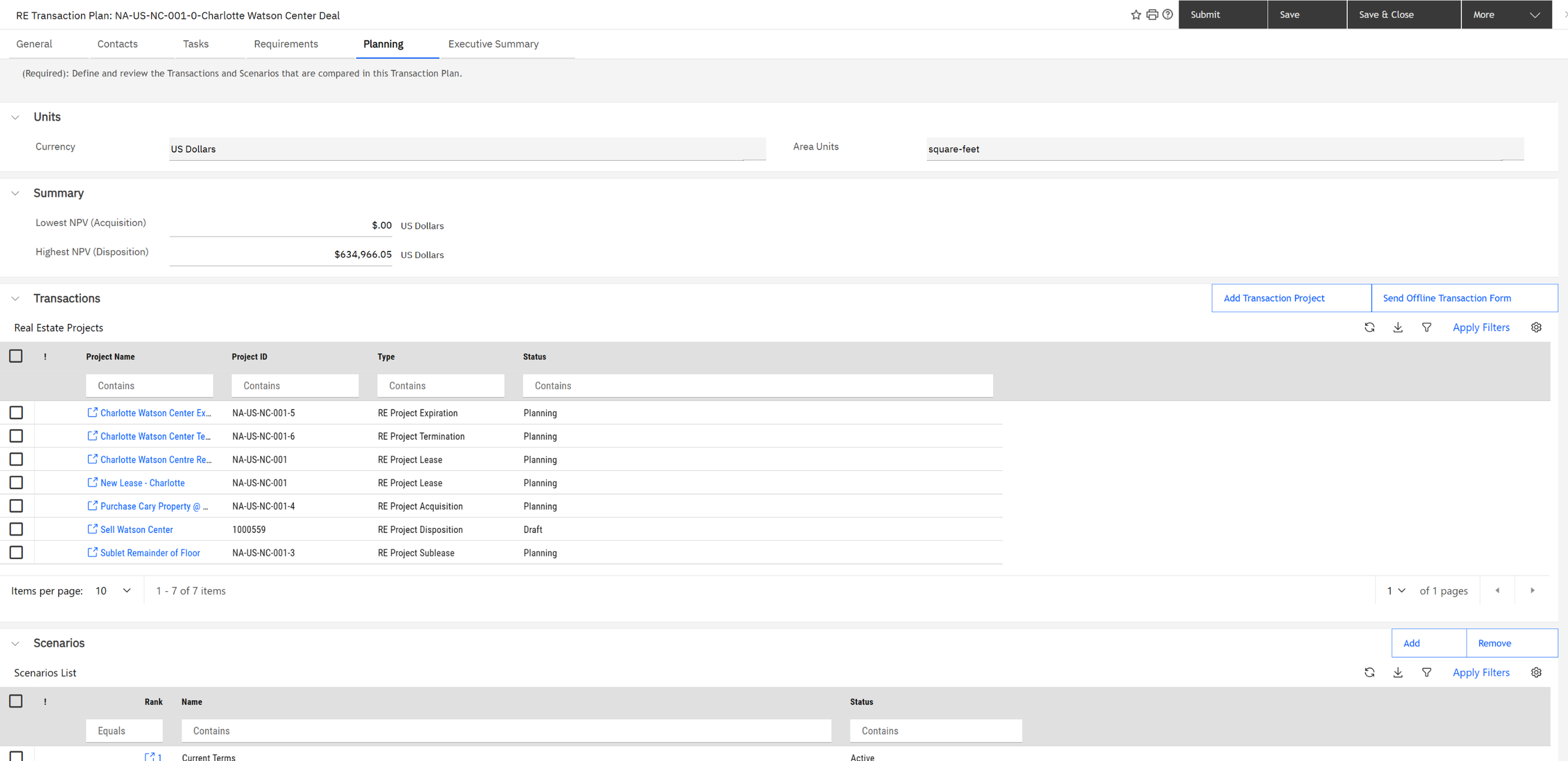
| Transaction project | Type | In plain words |
|---|---|---|
| Charlotte Watson Center Expiration | Expiration | Let the lease end and leave. |
| Charlotte Watson Center Termination | Termination | Use the break option and leave early. |
| Charlotte Watson Centre Renewal | Lease renewal | Stay, on new terms. |
| New Lease – Charlotte | New lease | Move to another rented building. |
| Purchase Cary Property | Acquisition | Buy a building and move there. |
| Sell Watson Center | Disposition | Sell an owned property. |
| Sublet Remainder of Floor | Sublease | Keep the space and rent out the part not used. |
The options are then combined into scenarios, because real decisions are combinations: "let the lease expire and sign a new lease", or "renew and sublet half a floor". The first scenario is always Current Terms: doing nothing, the baseline every other scenario must beat.
Add Transaction Project creates a new option; Send Offline Transaction Form sends one to a broker or a landlord to fill in outside MREF, and their answers come back into the plan.
Chapter 4Scoring a scenario: the Σ metrics
Open a scenario and its Summary Metrics show two things: the money, and a set of scores.
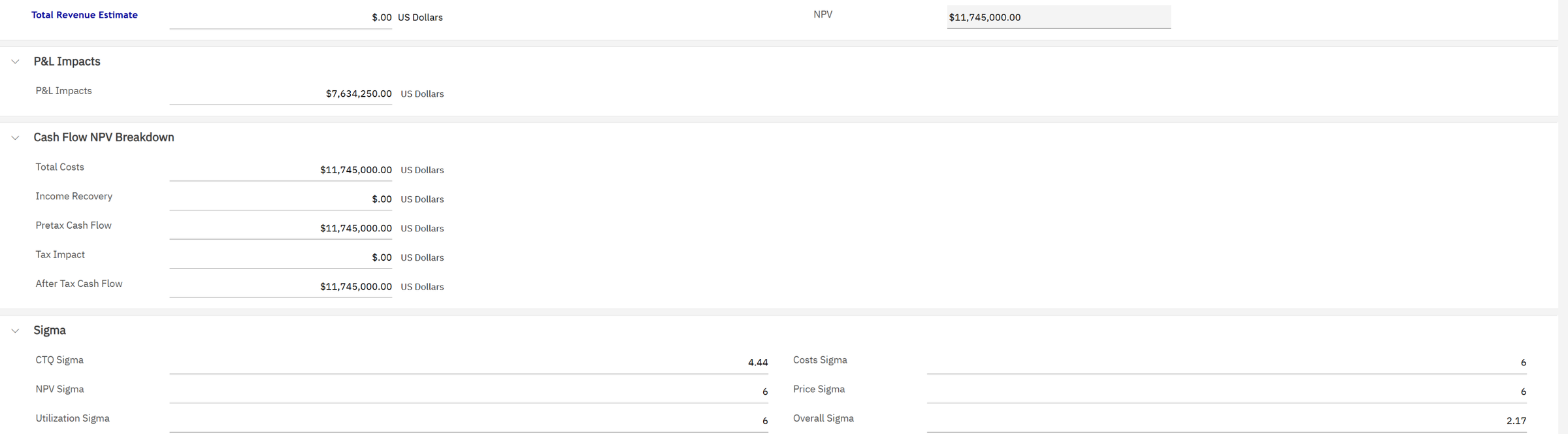
Net present value brings every future payment back to today's money, using a discount rate. $1M paid in ten years is worth less than $1M paid today, so NPV lets you compare a cheap-now-expensive-later option with an expensive-now-cheap-later one on equal terms. In this plan the scenarios are mostly costs, so the NPV is the present value of what the scenario will cost: the smaller, the better.
Each metric is converted to a sigma score, the Six Sigma scale where 6 is near-perfect. CTQ scores how well the scenario meets the requirements of Chapter 2; NPV, Utilization, Costs and Price score each dimension; Overall combines them. The scores put money and fit on one scale, so a cheap scenario that misses half the requirements cannot win on price alone.
Current Terms scores 6 on NPV, utilization, costs and price, yet only 4.44 on CTQ and 2.17 overall. Staying put is financially the baseline, but it does not meet what the business asked for. That gap is the reason the plan exists.
Chapter 5The executive summary
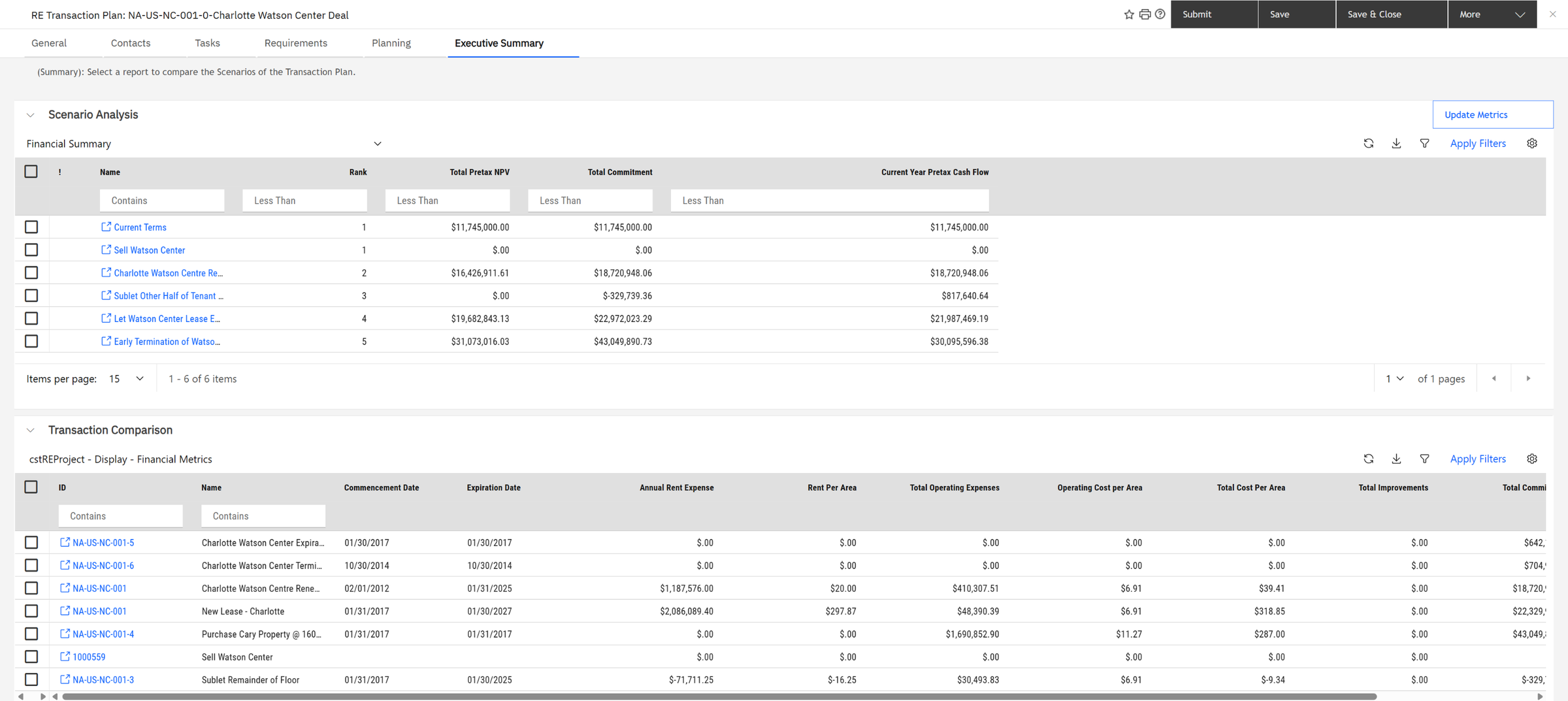
The Executive Summary tab is the page for leadership: every scenario ranked, and every transaction project compared column by column.
| Scenario | Rank | Total pretax NPV | Total commitment |
|---|---|---|---|
| Current Terms | 1 | $11,745,000 | $11,745,000 |
| Sell Watson Center | 1 | $0 | $0 |
| Watson Centre renewal | 2 | $16,426,912 | $18,720,948 |
| Sublet other half of the floor | 3 | $0 | −$329,739 |
| Let the lease expire (and move) | 4 | $19,682,843 | $22,972,023 |
| Early termination | 5 | $31,073,016 | $43,049,891 |
Commitment vs. NPV. The renewal commits $18.7M of payments, but they are spread over years, so in today's money they are worth $16.4M. The gap, $2.3M, is the effect of discounting.
A negative commitment. Subletting shows −$329,739: the scenario brings money in rather than paying it out.
Leaving early is expensive. Early termination costs $31.1M in NPV against $16.4M for renewing: the termination fee, plus paying for new space sooner. The summary makes that visible in one row.
The lower table, Transaction Comparison, is where the analyst checks the drivers: annual rent, rent per area, operating expenses, cost per area, improvements and commitments for each project. The renewal, for example, carries $1,187,576 of annual rent at $20 per sq ft and $410,308 of operating expenses; the sublease shows a negative rent (−$71,711), because it is income.
The renewal's rent per area is $20 (per square foot), the new lease's is $297.87. Not fifteen times more expensive: the new lease is recorded in square meters. $297.87 ÷ 10.764 ≈ $27.67 per sq ft. Check the units field of each project before comparing per-area numbers.
Chapter 6From the chosen deal to the lease
Once a scenario is chosen, its transaction projects become real deals. The new lease's Financial Terms tab holds the negotiated terms, and they become the lease abstract the lease administrator works with afterwards.
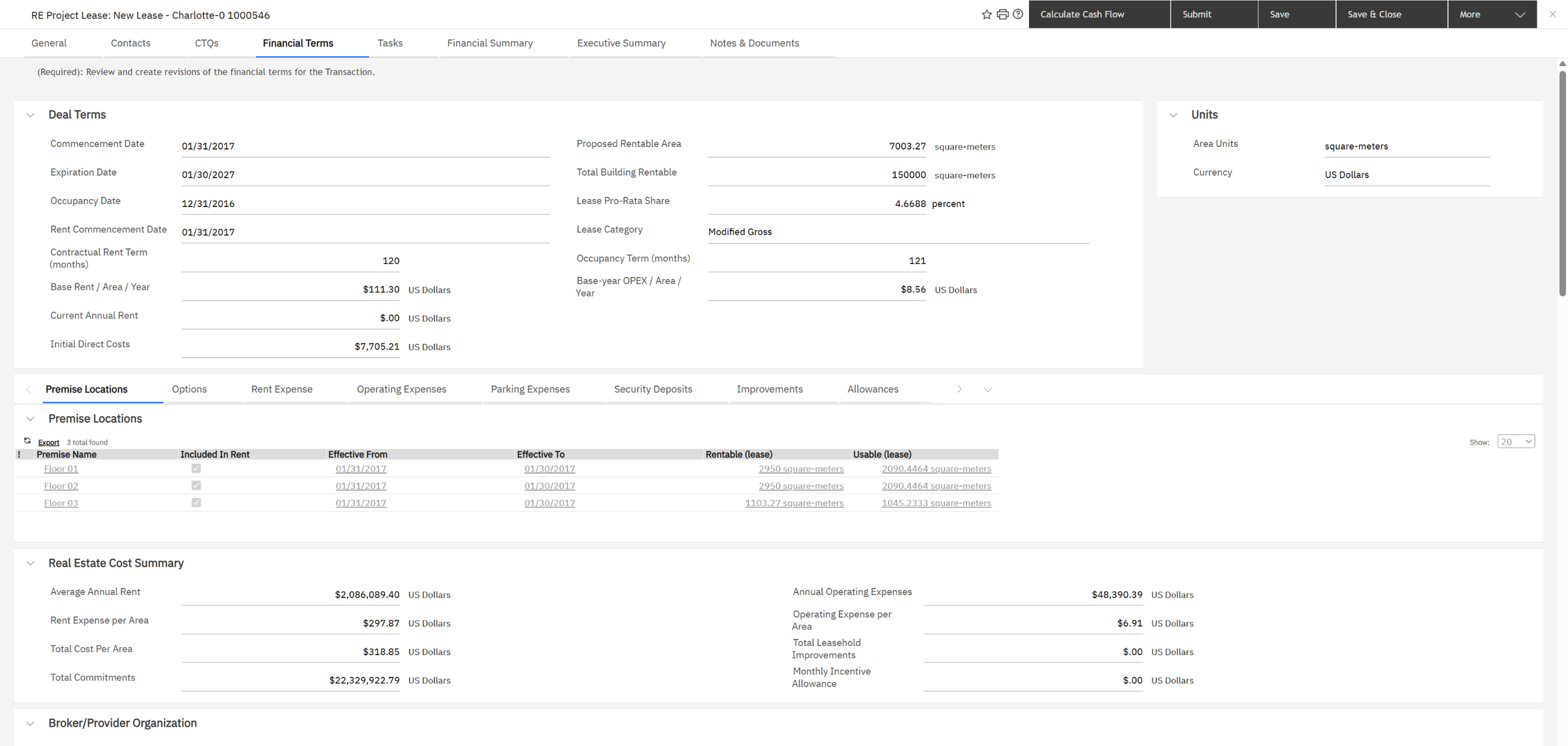
Area. Floors 01, 02 and 03: 2,950 + 2,950 + 1,103.27 = 7,003.27 m² rentable, the proposed rentable area.
Pro-rata share. 7,003.27 ÷ 150,000 m² (the building) = 4.6688%, the share of the building's operating costs GreenPoint will pay.
Operating cost per area. $48,390.39 ÷ 7,003.27 = $6.91 per m², as shown.
Average rent per area. $2,086,089.40 ÷ 7,003.27 = $297.87 per m², as shown.
A free month. Occupancy starts 31 Dec 2016, rent starts 31 Jan 2017: occupancy term 121 months against a rent term of 120. The tenant moves in a month before paying rent, which is a typical incentive for fit-out.
The tabs underneath (Options, Rent Expense, Operating Expenses, Parking, Security Deposits, Improvements, Allowances) are the same building blocks as in a lease. Calculate Cash Flow rebuilds the financial model from them, and the results feed back into the plan's comparison.
It is the same pattern as a purchase requisition becoming a purchase order: the negotiated terms are carried into the contract record, not retyped. Here, the deal's terms become the lease abstract in lease administration, with its dates, payments and accounting.
What this gives the organization
- Fair comparisons. Every option measured against the same requirements, with the same financial model.
- Today's money. NPV and commitments side by side, so long cheap deals and short expensive ones compare honestly.
- Fit, not just price. Sigma scores combine cost and requirements into one ranking.
- A decision record. Why this option was chosen, with the alternatives, kept for audit and for the next renewal.
- No retyping. The chosen deal's terms flow straight into the lease.
Check yourself
1. Why is "Current Terms" always the first scenario?
It is the baseline: doing nothing. Every other scenario has to beat it to be worth the effort and the risk.
2. A scenario commits $10M over 10 years. Is its NPV higher or lower than $10M?
Lower, for a positive discount rate: payments in later years are worth less in today's money.
3. Two leases: $22 per sq ft and $240 per m². Which is cheaper per area?
$240 ÷ 10.764 ≈ $22.30 per sq ft, so the $22 per sq ft lease is slightly cheaper.
4. A scenario has the lowest NPV but a CTQ score of 2. What does that tell you?
It is cheap, but it does not meet the requirements. The overall score, not the NPV alone, should drive the decision.
5. Why does a sublease have a negative commitment?
Because it is income: the subtenant pays GreenPoint, which reduces the scenario's total cost.
Glossary
- Transaction plan
- The record that governs a real estate decision: requirements, options, scenarios and comparison.
- Transaction project
- One option in the plan: renewal, new lease, purchase, sale, sublease, expiration or termination.
- Scenario
- A combination of transaction projects that together answer the business need.
- CTQ
- Critical to quality: a measurable requirement such as area, budget, date or location.
- NPV
- Net present value: future payments brought back to today's money with a discount rate.
- Total commitment
- The sum of all payments a scenario commits to, not discounted.
- Sigma score
- A score on the Six Sigma scale (up to 6) that puts different metrics on one comparable scale.
- Disposition
- Selling or otherwise getting rid of a property.
- Pro-rata share
- The tenant's area as a percentage of the building, used to split operating costs.
- Rent commencement
- The date rent starts, which can be later than the date the tenant moves in.
Want to see this with your own portfolio? Send me a message and I'll set up a demo.
Screens: IBM Maximo Real Estate and Facilities on IBM Maximo Application Suite, with IBM's GreenPoint demo data. All names, amounts and dates are demo values.